
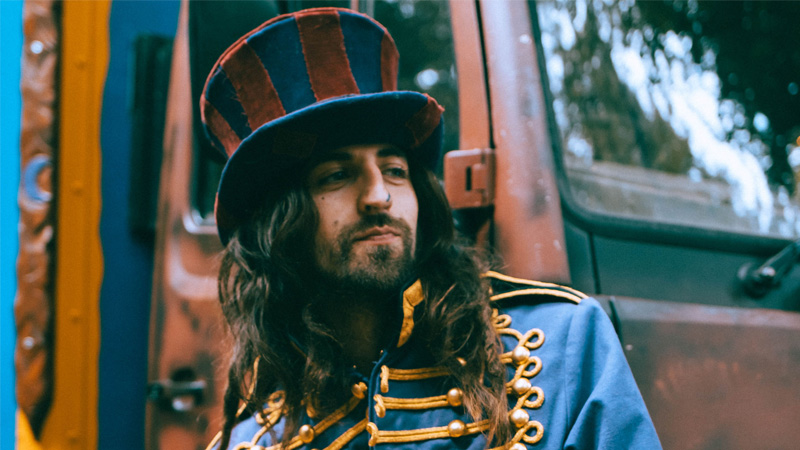
Cam Cole — Lost In Creation: Bigger, Stranger and Still Built to Stomp
Cam Cole made his name by seeing how much sound one person could make. Guitar, footdrums, a rough-edged voice and enough rhythmic force to make a street corner feel too small became both the music and the spectacle. The one-man-band identity carried him from years of busking into international touring, viral live clips, a cameo on Ted Lasso and the American Mileage documentary, where his path crossed with living blues figures including Bobby Rush, Jimmy “Duck” Holmes, R.L. Boyce and Kenny Brown.
Lost In Creation arrives at the point where that description is no longer enough. The blues is still underneath everything, but the fourth Cam Cole album opens more doors: grunge, alternative rock, psychedelia, folk, stoner-rock weight, studio atmosphere and moments of real vulnerability all move through the frame. The important part is that the expansion does not make Cole sound polite. The distortion still bites, the rhythms still lurch, and the record is at its best when the music feels a little dangerous and a little strange.
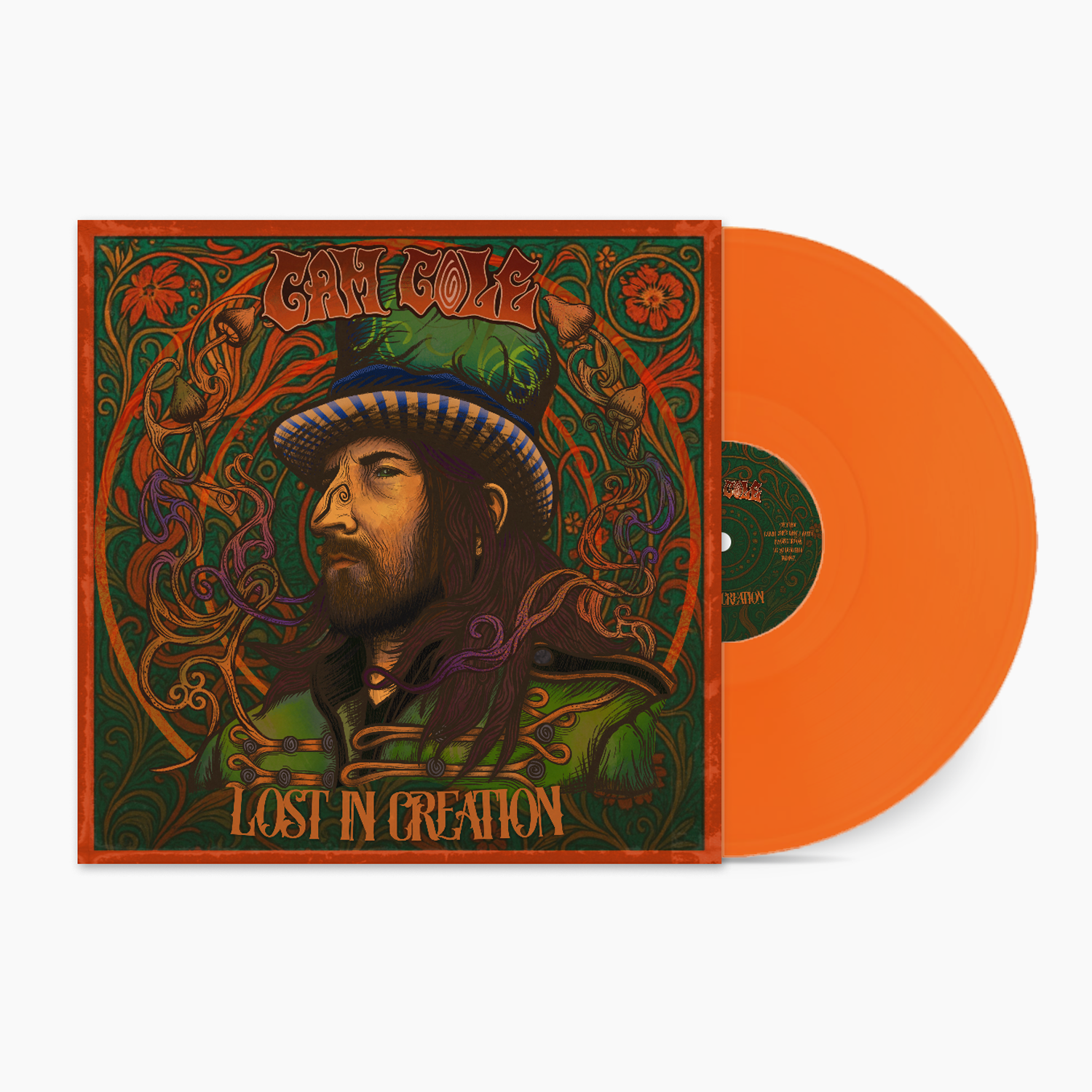
Lost In Creation album artwork supplied with the press materials.
The Wall Gets Wider
Cole says the change was deliberate. His first three albums were largely built around capturing the thing people had already responded to on the street: one person playing everything at once, with only subtle overdubs used when necessary to make a guitar sound thicker rather than to create an obvious second part.
| “It’s the fourth album now. I could either keep doing what I’ve always been doing, or I could paint with it a little more and express myself in a way people haven’t really heard before.” — Cam Cole |
That word — paint — gets close to what Lost In Creation does differently. Cole still records the core guitar and drums live, usually choosing the second or third take when the feeling is right. But now he is willing to build around that foundation with additional guitars and sounds. The raw performance remains the cornerstone; the studio becomes another instrument instead of merely a place to document the show.
That also means being willing to throw the foundation away when it does not feel right. “Get Up Ya Honky Tonk” became the problem child of this album. Cole went back to it, remixed it several times and kept hearing something he did not trust. Now he can listen and hear nothing wrong with it. At the time, however, it was the one song that refused to arrive easily.
A Record That Keeps Changing Shape
The opening run makes the new range obvious. “Fee Fi Foe” comes in dark and dirty, with grungy slide guitar, heavy distortion and a vocal treatment that sounds pushed through an old PA. There is some Jack White abrasion in the attack, but the stranger rhythmic personality keeps it from feeling like imitation. It is blues-rock dragged through fuzz, grime and a modern alternative-rock filter.
“Rabbit (She’s What I Want)” leans further into alternative rock. There are flashes of Nirvana and Corrosion of Conformity in the weight and texture, but the heaviness does not bury the emotional center. There is real longing in it — not just a lyric about wanting someone, but the sound of wanting someone. “Chasing Dreams” changes the temperature again with a catchier, more immediate pulse. It is one of the album’s most accessible tracks, proof that Cole can make the sound easier to enter without sanding off his personality.
“Ur So Beautiful” is one of the record’s most revealing turns. On first listen it carries the dark acoustic weight of the 1990s unplugged era — Alice in Chains and Stone Temple Pilots are fair touchstones — but Cole confirmed that the grunge intention is absolutely there. Delta blues may be the foundation of his music, he says, but grunge, psychedelia and a little Josh Homme-style desert rock are major parts of his vocabulary too.
| “Grunge is a humongous genre for me… I especially like mixing the blues with the grunge.” — Cam Cole |
The song came from a more personal place than its darkness might suggest. Cole wrote it while caught in the honeymoon-stage infatuation of a relationship that ultimately did not last. He walked into the studio with the feeling already present, turned it into a song and, with Valentine’s Day approaching, sent it to her. His summary of the result is considerably less poetic: “That got me in there.”
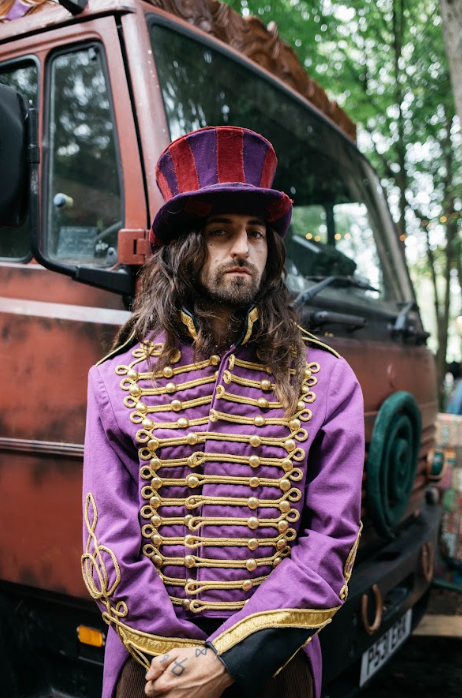
Cam Cole. Official press image. Photo: Tomm Morton.
The middle of Lost In Creation gets rougher and more playful. “Tailgate” piles on distortion and gives Cole’s vocal a near-spoken, almost rap-like cadence. “Feeling Me Now” seems to drag itself into motion before snapping into a faster, heavier groove, with rhythm doing as much work as the riff. Cole says the song also represents another small technical breakthrough in his foot-drum playing: a four-to-the-floor feel and double tambourines he had not previously been able to execute the way he wanted.
Then comes “Get Up Ya Honky Tonk,” the track that best explains what happens when Cole lets the weirdness stay weird. To these ears, it sounds like blues wandered into a Primus rehearsal: crooked, funky, stomping and playful, with raw guitar and a distorted radio-like vocal cutting across the groove. Cole laughed at the comparison because other people have told him something similar — and because he has barely listened to Primus. He knows a little of the band, but not enough to have consciously borrowed anything. That makes the rhythmic resemblance more interesting, not less.
| The record works best when Cole lets the weirdness stay weird. |
Mississippi, Slide Guitar and “Shroom Swamps”
Cole’s American mileage matters here, but not as a convenient explanation for the whole record. In the interview, he connected Mississippi most directly to the way he heard new possibilities in slide guitar and to the value of looseness — influences that became especially concrete in one instrumental.
He has long felt that slide guitar can do more than remain inside familiar blues structures. In Mississippi he became interested in bridging the recognizable architecture of 12-bar blues with different scales and chordal movement. Then a particularly strange day in the cypress swamps turned that theory into a song.
At an earlier show, a fan had given Cole psychedelic mushrooms. He forgot them in a pair of jeans. Later, during time off in Mississippi, he found them again while wearing those trousers and visiting the swamps. He ate them, discovered they were much stronger than expected, became increasingly aware of the possibility of alligators and retreated to the pickup truck with a camper body he was renting. There, guitar in hand, the musical idea clicked.
| “It is exactly what it says on the tin. It was a psychedelic adventure in the swamps of Mississippi, and it was a sound I was looking for.” — Cam Cole on “Shroom Swamps” |
Cole put down his phone and recorded what he was playing. That sketch became “Shroom Swamps,” later expanded with drums. It happened during the same stretch in the States when he interviewed Bobby Rush. The instrumental is one of the album’s most vivid pieces: creepy Delta-flavored slide, psychedelic atmosphere and the feeling of walking through mud with every step resisting the next one. On the record it sits immediately before the title track, functioning like a murky passageway into the final statement.
The trip also sharpened another lesson. Around Bobby Rush and R.L. Boyce, Cole heard musicians who were not obsessed with perfect edges. He was struck by Boyce’s willingness to let the playing get messy if the vibe was right. The takeaway was not to become careless; it was to understand that precision is not the only kind of control. “If you can save it in time, it sounds in,” he said. That looseness is now part of what he wants to carry forward.
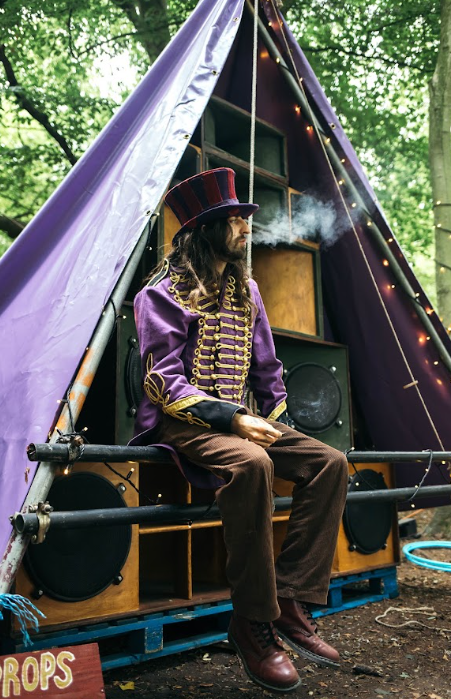
Cam Cole. Official press image. Photo: Tomm Morton.
The Work Is Part of the Show
Cole never planned to become a one-man band. The songs and the imaginary band in his head came first. After being repeatedly let down by drummers, he moved from a stomp box to adding a tambourine, then tried using both feet at once. Eventually he found the Farmer FootDrum and began the long process of teaching his body to do what his arrangements required.
The setup is now customized, partly because Cole hits it hard enough to break things. Pete, the builder, has helped modify the levers so they return properly, though Cole says he can still “break the bastard” and values having a tech nearby when that happens. Each record tends to bring a new beat or another piece of coordination he did not have before.
That difficulty is not something Cole wants to hide with electronics. He has considered simplifying his street and live setup into a smaller digital system, but he thinks doing so would remove one of the reasons people stop. He spent roughly seven years busking before the final three years became genuinely profitable. The difference, as he sees it, was not convenience. It was finally building a show where a passerby could look at the physical effort and immediately understand that what they were seeing was hard.
| “People on the street don’t give you any time unless you’re giving them something. You’ve got to hypnotize them.” — Cam Cole |
When that happens, the reaction still matters to him. Asked what it feels like to see someone in a crowd become completely absorbed, Cole answered without hesitation: he loves stopping people. “That’s what I live for.”
Away from the road, he is already writing again, working out the show for an upcoming February tour and continuing his “Sounds From The Van” videos. His restlessness reaches outside blues-rock too: he keeps an electronic dance-music project as another outlet for ideas that do not belong inside the Cam Cole sound. He talks about songwriting as capturing lightning in a bottle, and about the stage as something that can always be pushed further — even down to visual devices such as the large spiral wheel he uses behind him. The one-man-band concept may be expanding, but the instinct to make people stop and look remains intact.
Vulnerability, One Takes and the Rooms That Matter
The final three tracks deepen the record rather than simply making it louder. “You Shall Be Saved” begins stripped down and vulnerable, then widens without losing the exposed quality at its center. Cole wrote it in the same general batch as Unleash, but it was too singer-songwriter-oriented to belong comfortably on that heavier album. Lost In Creation gave it a better home.
The song dates to the pandemic period and the collective feeling of watching livelihoods, small businesses and ordinary stability disappear. Its message is not that music magically fixes any of that. It is that if some part of you can still sway to the rhythm, there is at least something to hold onto. Cole admits he may have been trying to pick himself up as much as anyone else.
The performance has another layer of significance: the main vocal, guitar and drums were captured together in one take, with only a few backing vocals added later. That raw ending, where the vocal seems to lose itself inside the song, is not studio theater. It is the core performance itself.
“You Shall Be Saved” was recorded at Rockfield in Wales, where Cole also recorded Unleash. He points to the studio’s history with artists including Queen and Oasis, but what he values most is the ability to live there for a stretch, wake up and immediately work rather than carry the outside world into the room. Most of Lost In Creation, however, was recorded at Dean Street Studios in London, with Markus Stretz producing and mixing, and Sean Magee mastering at Abbey Road.
| “You only get to do this once with these songs. I could record them all at home on my laptop and a microphone, but there is a fucking difference.” — Cam Cole |
For Cole and Stretz, that difference is the room. They are self-described music nerds who care about how drums, guitars and voices react to a physical space. Dean Street and Abbey Road are not status symbols in that telling; they are tools. Cole points out that sometimes the magic space is not even a studio — it can be a corridor, a staircase or any place where the sound suddenly becomes bigger than the walls around it. He cites the famous stairwell sound behind John Bonham’s drums on Led Zeppelin’s “When the Levee Breaks” as the kind of accidental acoustic discovery musicians spend their lives chasing.
Getting Lost Without Losing the Stomp
“Shroom Swamps” needs no lyric at all. The title track that follows it does. “Lost In Creation” turns the album’s outward experimentation inward: darker, more reflective and lyrically direct, it sounds like an artist confronting the quantity of ideas in front of him and the difficulty of knowing which direction deserves to survive.
That is also why the album’s breadth works more often than it does not. What could look like genre-hopping across ten songs gradually starts to feel like the point. Cole is allowing himself to chase sounds until they tell him where they belong. The one-man wall of sound has become a room with more doors in it.
The record is not flawless. Its breadth can occasionally feel restless, and the distorted vocal treatment appears often enough that what begins as a striking texture can become expected. “Chasing Dreams” is immediately likable but less idiosyncratic than the album’s strangest material. Those are modest trade-offs for a record that is clearly trying to grow instead of simply repeating a successful formula.
The standouts are “Get Up Ya Honky Tonk,” “You Shall Be Saved,” and “Lost In Creation,” with “Shroom Swamps” functioning as the odd instrumental detour that gives the album a world of its own. More importantly, Lost In Creation answers the question hanging over the project: Cam Cole can expand the palette without losing the stomp. The blues is still underneath everything, but it is no longer a fence.
At the end of the interview, Cole resisted telling listeners exactly what they should understand about him when the album ends. That, he said, belongs to them. What he hopes they hear is the journey — the different flavors, the things he is pulling in, and the work of creating each song on its own terms.
| “I hope they understand the musical journey I went on to make the album… Anything else they take from it is a bonus. That part is up to the individual.” — Cam Cole |
That is probably the right final word. Lost In Creation is not a clean arrival at a new identity. It is the sound of an artist discovering how much more the identity he already built can hold. Getting lost, this record argues, is not the same as being defeated.
And Cole does not sound finished with the journey. As the conversation ended, he said he expects to return to the United States soon. For a musician whose career began by forcing strangers to stop, the next chapter may be less about proving how much noise one man can make and more about seeing how far that noise can travel.