
Still Glowing: Robin Trower reflects on his career
There are a number legendary blues-rock guitarists who have maintained a lofty status. But often it’s largely through reputation rather than continuing artistic contribution.
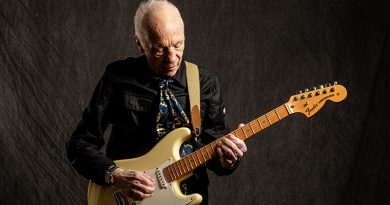
Not so for British legend Robin Trower, who has consistently maintained a powerhouse presence through seven decades. Just concluding a tour at age 81, Trower has been more prolific in recording and touring than ever before.
Since leaving Procol Harum in 1971, where he appeared on eight albums, Trower has produced 41 studio and live albums with 10 of those coming in the last 10 years. And during this past decade, he averaged one tour per year. In 2025-2026 alone he released Come And Find Me, and Shine along with One Moment In Time: Live In the USA. In addition to these solo efforts, he has teamed up with Jack Bruce for six albums and Bryan Ferry for still another four albums since launching his solo career.
Trower recently discussed his career and legendary sound with Blues Rock Review (BRR).
Procol Harum had achieved superstar status with hits like Whiter Shade of Pale but Trower decided it was time to venture out on his own and take charge of his career as a solo artist. “I think it was just simply because I had started to write a lot more music, you know, guitar songs. And I needed to get away from Procol to start building up that material,” he told BRR.
With a strong need to write guitar-based material, Trower said that playing and writing are equally important to him. “I think the two are so interlinked. I think it’s hard to separate them. It’s the guitar part that enables me to create the new songs, so you know, they go hand-in-glove.”
There’s little doubt that Trower’s emotional depth in his playing and a completely unique sound are what keep him at the fore of blues-rock guitarists. Brian May and Jeff Beck are among the handful with such instantly recognizable sounds.
But Trower shrugged off the feat, saying simply, “I think I’ve kept to the same formula, really right across the past 50 years, you know, the Stratocaster (guitar), the Marshalls (amps), and an overdrive. That is the core of how I get my sound.”
When BRR noted that his fans have been fiercely loyal and speculating that it’s because of his unwavering belief in himself and playing exactly what he wants when he wants, Trower agreed. “Yeah that’s true. I’ve been very, very fortunate to be able to sort of plough my own style, really. And it started way back now, when my manager of the time, Derek Sutton, had the idea of us forming our own label. So I was able to just do what I wanted, musically.”
He also agreed that the honestly of his work is what keeps his fans on board. “The whole idea behind what I do is I just try and make it as soulful as possible, therefore, it’s gonna come from within, you know, it’s the soul thing as well as a mind thing.”
Reflecting on his prolific schedule in recent years, he attributed it to the fact that he’s still having fun and his passion is to be creative. “If I keep coming up with songs, I’ve gotta keep recording. That’s basically the truth. The whole creative process is very, very rewarding. You know, it makes the days really glow and shine,” he revealed.
Trower’s live shows have almost exclusively been presented as a trio since his early days with James Dewar (who passed away in 2002) as his bassist and lead vocalist, and drummer Reg Isidore (later Bill Lordan).
He acknowledged the trio format offers its own challenges but said, “The thing about working in the three pieces, is that everybody in it really has to work harder to make up for the instrument that’s missing. And I think I enjoy the challenge of that.”
Currently, he’s working with Richard Watts on bass and vocals and Chris Taggart on drums. The recent live tours in 2025 and 2026 have repeatedly garnered high praise in reviews. “I love working with those guys. They’re both absolutely very, very talented musicians. That’s the thing and I’m very fortunate, very fortunate indeed,” he stated.
A few years back, Trower produced an album called Seven Moons and the trio included superstars Jack Bruce on vocals and bass and Gary Husband (Alan Holdsworth) on drums, but Trower insisted the ‘supergroup’ moniker was not a factor.
“I don’t think we were thinking that. Jack and I got together. We wrote some songs and he recommended Gary, who was a brilliant drummer, and it was just, ‘Let’s make this album and have some fun.’ I guess that’s key – the fun of it. That’s really what it’s all about, isn’t it?”
Among Trower’s most dynamic recordings are his live efforts and he discussed their production, revealing that he is very much hands-on. “Obviously it’s gotta sound great, but it’s gotta feel great to me. That’s the thing, it’s got to feel good.” He explained, “The (final) production quality has got a lot to do with the recorded sound. I was lucky enough on the latest live one (One Moment In Time: Live In the USA) to have a great engineer (James Kane) recording. And then another great engineer (Sam Winfield), helped me mix it.”
There are always opinions about any given recording and Trower is often his own toughest critic but says the process isn’t that difficult. “Although, there’s always sort of a little bit of that doubt, if you can say to yourself well, I don’t really have to do it much better, that’s the winning key, really. You want to get it to a point where it’s beyond where you think, I could do it better.”
And he’s been happy with recent tours in the US, noting, “I have to say, in general, the USA is always great audiences. You know, I think, there are no particular areas where it sort of goes up a notch. I think it’s always good.”
Returning to the topic of his uniquely distinct sound, the veteran says he hasn’t been overly influenced by too many other guitarists but acknowledged a few. “I mean, Scotty Moore (Elvis Presley’s guitarist) being number one, because of him I wanted to play guitar in the first place,” he said. “There are others that I don’t say have had a huge influence, but all fed into where I was growing. You know, the early rock and roll players like Gene Vincent’s guitar player (Cliff Gallup), Chuck Berry, Bo Diddly, these all had an influence. And then the next big influence was B.B. King. Yeah. And then Jimi Hendrix and Albert King came along a little bit later.”
Younger artists have often credited Trower with being a huge influence on them but he is humble as he shrugs off his role as an influencer. He laughed, “I’m not sure I’m helping young players, to be honest.”
Still others have acknowledged how gracious Trower was to them when they opened for him early in their careers. “Oh, that’s nice. Thank you very much. That’s very nice to hear,” he concluded.