
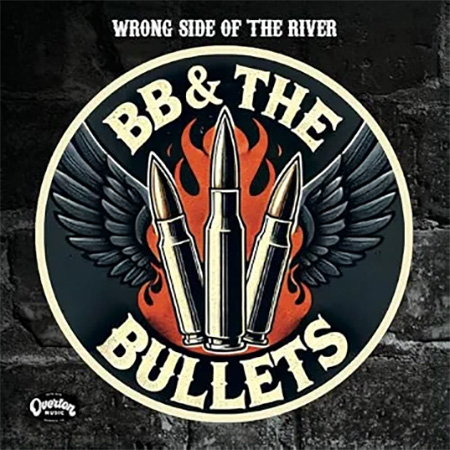
BB & The Bullets: Wrong Side Of The River Review
By the time I spoke with Brian Baker, I had already spent enough time with Wrong Side Of The River to know what I liked about it. What I did not expect was to meet him inside the room where the entire album had been made. Baker was sitting in his home studio in Whanganui, New Zealand, the same space where BB & The Bullets tracked the record and where he produced, recorded and mixed it. The setting fit him. He came across as a regular rock-and-roll cat – easygoing, obsessive about songs and completely unpretentious – but also very clear about the band’s direction. “I wanted to establish us in the genre,” he told me. “We’re blues rock.”
BB & The Bullets are Baker on guitar and lead vocals, Stu Duncan on bass and backing vocals, and Brad McMillan on drums and backing vocals. Wrong Side Of The River is their second album and contains ten Baker originals plus Peter Green’s “Oh Well.” The band’s press materials describe it as the follow-up to 2025’s High Tide, released on the French Dixiefrog label, and note that the debut reached No. 1 on the Roots Music Report Blues Rock Album chart. Baker calls the new record a continuation of that first album, but he also wanted it to be a step forward – a clearer statement of who the trio is.
The title is rooted in Whanganui itself. Baker said he was riding his bike near the railway tracks when the old blues phrase “the wrong side of the tracks” crossed his mind. Then the local landscape took over: “I went, ‘The wrong side of the river.’ Actually, no one’s really done that. That’s sort of a perfect blues thing.” He talked about Whanganui as a place shaped by water, bridges and the river running through the city. That sense of place matters. The album is not trying to pretend it was made in Mississippi, Texas or Chicago. Baker knows where the blues comes from, but he is letting his own surroundings into it.
That same mix of tradition and personality drives the strongest songs. “Midnight Rider” opens with a bright, twangy bounce that immediately flashed Glenn Frey’s “Partytown” for me before the song settles into a tougher Texas-blues attack. Baker did not know the Frey song when I mentioned the resemblance, but his roots-rock history runs deep: he bought Tom Petty and the Heartbreakers’ first album the day it came out in New Zealand and still considers Petty a major influence. “Wild Honey” backs things down into a roomy, old-school Texas-blues rhythm. Then “Freak Show” changes the temperature completely. Its dirty, repeating riff and hypnotic pulse bring Mississippi hill country to mind, especially R.L. Burnside. Baker immediately understood the connection. He described the rhythmic source as deep blues mixed with a country two-step, then added that the song also has “roots in ZZ Top, although you can’t really hear it.” You can – at least around the edges. “Freak Show” is the record’s most distinctive track and its best shot at pulling in listeners who think they already know what a blues-rock trio is supposed to sound like.
The title track is the album’s best straight slow blues: cool, deliberate and confident, with the groove doing as much work as the guitar. “Get A Little Real” stays closer to familiar territory, but Baker’s solos give it some bite. “Sometimes You Lose Yourself” is stranger and more addictive. Its loose swing suggests Dire Straits, while the bounce gave me an unexpected flash of The Escape Club’s “Wild, Wild West.” Baker had not made either connection himself; vocally, he said he was reaching toward a little Elvis in the lower register. Lyrically, the song comes from relationships, breakups and the work of becoming whole again. That mixture of familiar pieces arriving from different directions is exactly why it works.
“Black Crow” adds another New Zealand wrinkle. Baker began writing its rhythm while in Chicago for a guitar seminar, and the lyric is about depression – the black crow entering the room and eventually landing on your shoulder. He also hears a trace of Pasifika music in the rhythm, the South Pacific reggae-like sway that is part of New Zealand’s musical environment, which the band then pushed toward a Rolling Stones feel. “The Buddha Song” finds a smart tension between a meditative idea and a guitar solo that refuses to stay calm. “She Knows” sneaks an old-school hip-hop pulse into the drums, while “Crawl Right In” leans farther toward rock with a Kenny Wayne Shepherd-like push and enough immediacy to live comfortably outside strictly blues programming.
The rhythm section is a big reason all of this stays grounded. When I mentioned hearing a John Bonham-like weight in McMillan’s playing, Baker laughed because it was not accidental. McMillan is a serious Bonham devotee, down to the way he sets up and tunes his kit. Instead of damping everything down, he wants the drums open, tuned and resonant – what Baker called “a big resonant machine.” Baker approaches production with the same sense of purpose. He does not define producing as simply choosing tones; he thinks about “how the songs, and the sound, and the artist, and the audience all react to each other.” Some songs carry ten or twelve guitar tracks, but his goal is “to illustrate rather than overwhelm.” That is the important part: despite the layering, the record rarely feels overproduced.
The lone cover, Peter Green’s “Oh Well,” fits that philosophy. Baker wanted one song that could serve as a touchstone back to British blues and British blues-rock, a tradition he feels New Zealand musicians have a natural affinity with. The band already knew the song worked live, but McMillan did not want to simply copy Fleetwood Mac’s original drum feel, so he pushed it toward Bonham. Baker hears Peter Green, Jimmy Page and Jeff Beck as part of the same British melting pot. “It touches our British rock, it touches Led Zeppelin, it touches the blues in a really cool way,” he said. Their version swings, the vocal has an old-room immediacy, and the choice feels connected to the band rather than dropped onto the record as a obligatory cover.
There is still a tradeoff. Several songs share the same tonal palette and blues-rock center of gravity, and over a full listen a few riffs and tempos begin to overlap. That is the one thing keeping Wrong Side Of The River from feeling like a 9/10 record to me. But the more time I spent with it – and especially after talking with Baker in the room where it was made – the more the album’s personality came into focus. This is not a band chasing every possible direction. It is a trio deciding exactly what it wants to be, then finding small ways to bend that identity without losing it.
Wrong Side Of The River is a great blues-rock record from a band that understands the tradition but sounds most alive when something unexpected slips into the groove. “Freak Show” has the deepest personality, “Midnight Rider” has the drive, and the title track proves BB & The Bullets can still make a straight slow blues feel cool without overworking it. Baker told me the band wants to tour the United States and has already received an offer from a venue in Philadelphia. If they make the trip, the album gives them a strong reason for people to show up.
The Review: 8.5/10
Can’t Miss Tracks
– Freak Show
– Midnight Rider
– Wrong Side Of The River
– Sometimes You Lose Yourself
– Oh Well
The Big Hit
– Freak Show